A stye and a chalazion can look almost identical at first. Both appear as a lump on the eyelid, and both can begin with redness and swelling. They start in different glands, though, and telling them apart usually comes down to three things: whether the lump hurts, where it sits on the eyelid, and how quickly it appeared.
Key takeaways
- A stye is usually a bacterial infection of an eyelash follicle or an oil gland, and it is typically painful.
- A chalazion is usually a blocked meibomian oil gland without an active infection, and it is usually not painful.
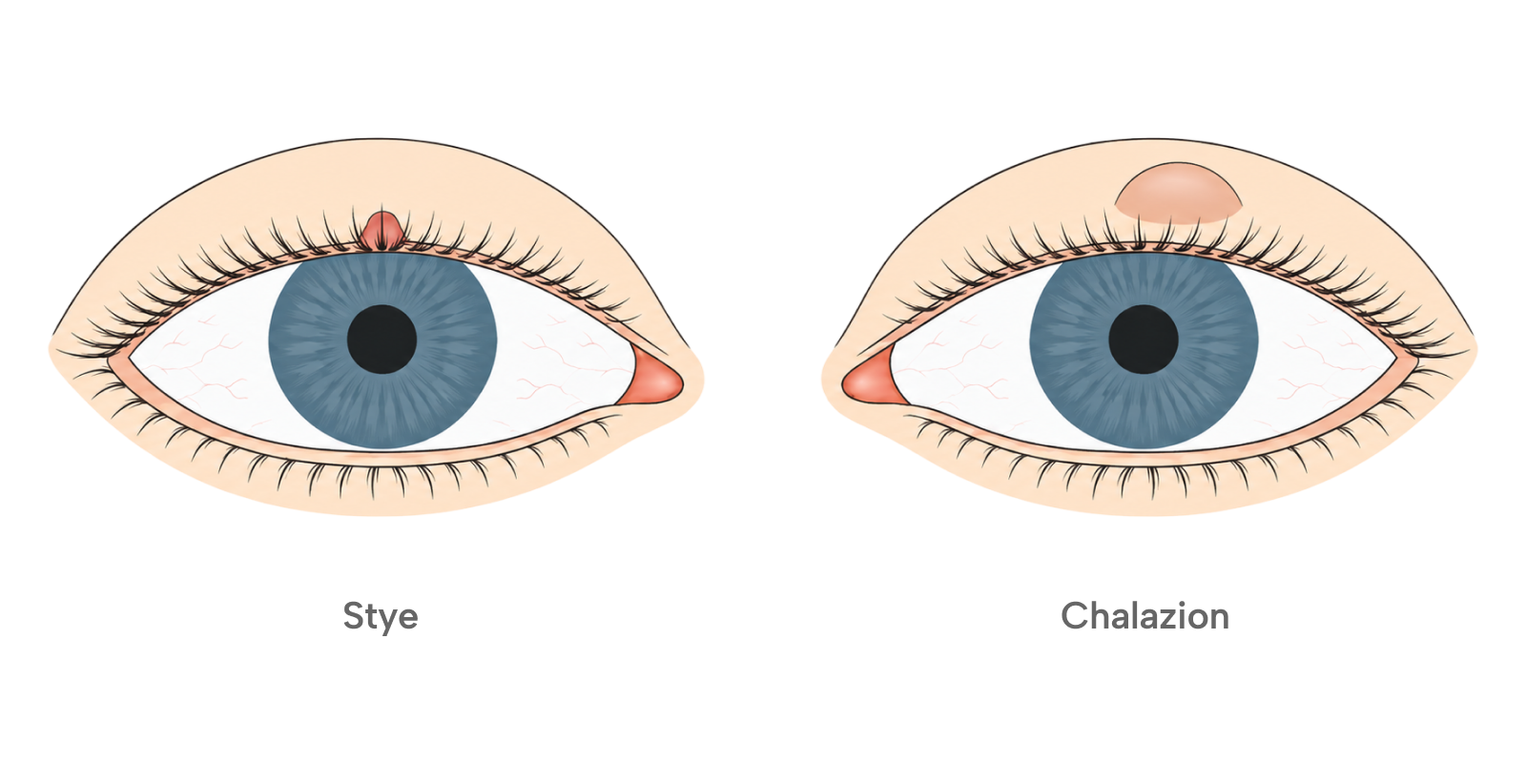
- Styes tend to sit at the eyelid margin near the lashes, while chalazia tend to sit farther back on the eyelid.
- A stye that starts deeper in the eyelid begins in the same gland that blocks in a chalazion, so location alone does not reliably separate the two.
- An eyelid lump that affects vision, spreads beyond the eyelid, becomes increasingly painful, or keeps returning in the same place is examined by an eye doctor.
What is a stye?
A stye, also called a hordeolum, is a red, tender lump that forms on or near the edge of the eyelid. It usually comes from a bacterial infection — most often Staphylococcus — in an eyelash follicle or one of the small oil glands along the lash line. Styes appear fairly suddenly, often over a day or two, and they are typically painful when the eyelid is touched or blinked. Blepharitis, a long-running inflammation of the eyelid margin, makes styes more likely.
A stye can start in a gland at the very edge of the eyelid or in one deeper inside, and the two do not appear in the same part of the eyelid.
What is a chalazion?
A chalazion is a firm, usually painless lump that forms when a meibomian gland — one of the oil glands inside the eyelid — becomes blocked. Unlike a stye, a chalazion is not usually caused by an active infection. Trapped oil and the eyelid's inflammatory response to it are what create the bump. Chalazia build up more slowly than styes, often over several days to a couple of weeks, and they usually sit farther back on the eyelid, away from the lash line.
Chalazia are more common on the upper eyelid than the lower one, which matches the upper lid holding more meibomian glands.
How do a stye and a chalazion differ?
Stye (hordeolum) | Chalazion | |
|---|---|---|
| Cause | Bacterial infection of an eyelash follicle or oil gland | Blocked meibomian gland, without active infection |
| Pain | Usually painful, especially when touched | Usually not painful, though early swelling can feel tender |
| Location | Often at the eyelid margin, near the lashes | Usually farther back on the eyelid |
| Onset | Fairly sudden, often within a day or two | Gradual, over days to a couple of weeks |
| Typical course | Often resolves within about one to two weeks | Most resolve within 2 to 8 weeks |
One more distinction is worth drawing here: both conditions sit in or on the eyelid. Redness that spreads across the white of the eye rather than staying on the eyelid points to a different group of causes, which are covered separately under bloodshot eyes.
How long do a stye and a chalazion last?
A stye often resolves within about one to two weeks, frequently on its own. A chalazion takes longer — most resolve within about two to eight weeks, and some persist beyond that. Both figures are typical ranges rather than fixed rules. A lump that is still growing, spreading, or affecting vision does not fit either range.
Can a stye turn into a chalazion?
It can sometimes happen, and where the lump starts explains why.
The eyelid holds two sets of oil glands. One set sits right at the edge, alongside the roots of the eyelashes. The other set, the meibomian glands, runs deeper inside the eyelid. A stye that starts in the glands at the lash line stays at the eyelid edge, and that is the kind most people picture. A stye can also start in a deeper gland — and a chalazion is one of those same deeper glands, blocked rather than infected.
A deeper stye and a chalazion therefore begin in the same place. What differs is what happened to the gland: infection in one case, a simple blockage in the other. Shared starting point is why the two can appear at the same spot on the eyelid, and why even an eye doctor may not be able to separate them in the first day or two.
When a deeper stye does not fully clear, the infection can settle while the gland stays blocked. The soreness fades, but the lump stays. What is left behind is no longer an infection — it behaves like a chalazion, and the change happens gradually rather than at one moment.
The practical difference is how long to expect the lump to last. Once a sore lump has stopped hurting and has settled into a firm bump, the one-to-two-week course of a stye no longer applies, and the two-to-eight-week range for a chalazion is the one to go by.
Important
Squeezing or trying to drain a stye or a chalazion can worsen irritation or spread infection instead of clearing the lump.
When should you see an eye doctor?
Most styes and chalazia clear on their own or with simple supportive care such as a warm compress. Some situations call for an examination instead of waiting. A large chalazion can press on the cornea and cause temporary blurred vision in one eye, and an untreated stye can spread into the surrounding eyelid tissue.
When to see a doctor
See an eye doctor if you have a change in vision, swelling that extends beyond the eyelid, redness spreading onto the face, increasing pain, loss of eyelashes near the lump, a lump that looks unlike a typical stye or chalazion, or an eyelid lump that has not improved after several weeks or keeps returning in the same place.
Medical information
This article provides general information about eyelid conditions and is not a diagnosis. Results vary by individual, and any decision about your own eyes should be made with an eye doctor who can examine them.