Most children who become nearsighted do so during the school years, and the change tends to continue for several years rather than settle after one new pair of glasses. Why the eye keeps changing, how an eye doctor follows that change, and what can slow it are three separate questions. The answers below come from a Korean ophthalmology consensus statement, national survey data, and Korean health screening rules.
Key takeaways
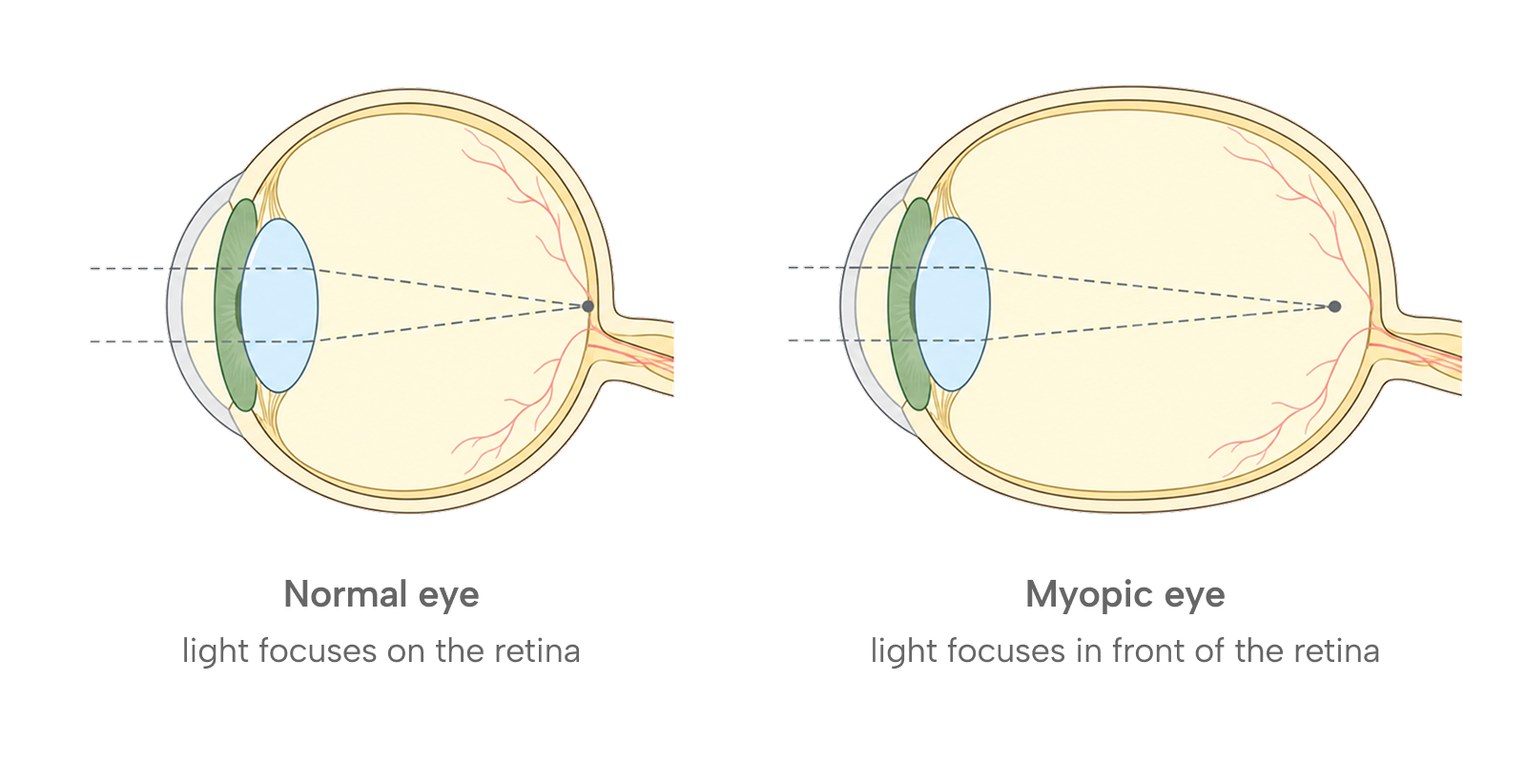
- Myopia in school-aged children is mostly axial, meaning the eyeball grows longer from front to back and distant images focus in front of the retina instead of on it.
- In the 2016–2017 Korea National Health and Nutrition Examination Survey, 65.4% of children and adolescents aged 5 to 18 were myopic and 6.9% had high myopia.
- The proportion of myopic children rose sharply from about age 7 and reached about 76% by age 13, after which it changed little.
- Children with myopic parents had 1.84 times the odds of being myopic, and 3.48 times the odds of having high myopia, as children whose parents were not myopic.
- The Korean Myopia Society advises at least 2 hours of outdoor time a day, near work held about 20 to 33 cm away or farther, and near work sessions of no more than 20 to 45 minutes at a stretch.
What myopia is, and why it usually begins in childhood
Myopia, or nearsightedness, means that distant objects look blurred because light entering the eye focuses in front of the retina rather than on it. According to the Korean Myopia Society consensus statement on myopia management in Korean children, myopia in school-aged children is predominantly axial myopia: the eyeball itself is longer from front to back than the eye's focusing power is matched to.
A child's eye is not a fixed size. It grows through childhood, and its focusing power normally adjusts as it grows. The consensus statement describes axial elongation as a response to where images fall relative to the retina, which is why the same growth process that ends in clear distance vision for one child ends in myopia for another.
Why myopia progresses during the school years
Korean survey data shows the ages at which myopia was more common. The 2016–2017 national survey was cross-sectional: it measured different children of different ages at one point in time rather than following the same children as they grew. In that survey, 15.0% of 5-year-olds were myopic, the proportion was higher from age 7 onward, reached about 76% at age 13, and differed little across the older age groups. High myopia followed a later pattern, rising from age 11 and levelling off after age 16, by which point about a fifth of 18-year-olds were highly myopic.
Age at onset matters for where a child ends up. The Korean consensus statement notes that the younger a child is when myopia develops, the more likely it is to progress to a higher degree, which is why children diagnosed at younger ages are followed more closely.
Family history is the other consistent signal. In the same Korean survey, children with myopic parents had 1.84 times the odds of being myopic (95% CI, 1.27–2.68) and 3.48 times the odds of having high myopia (95% CI, 1.28–9.46) as children without myopic parents.
Factors studied in relation to childhood myopia, with what has been observed for each and how settled the evidence currently is.
What has been observed | Where the evidence stands | |
|---|---|---|
| Age | Myopia becomes more common with each year of childhood | Consistent in Korean survey data (1.27 times the odds per additional year of age) |
| Parental myopia | Higher rates in children whose parents are myopic | Statistically significant in Korean survey data and reported in other cohorts |
| Time outdoors | Less outdoor time reported alongside earlier onset | Supported for onset; findings on slowing existing myopia have been inconsistent |
| Near work | Closer working distance and longer unbroken sessions reported alongside onset | Not statistically significant in the Korean survey after adjustment for other factors |
| Digital device use | Longer daily use reported alongside onset in some studies | Conflicting across studies; the Korean consensus notes randomized trials are lacking |
Age and family history are the factors with settled evidence, while outdoor time and near work habits are the ones a family can change. The two kinds of factor do not compete: the Korean consensus statement recommends lifestyle adjustment for every child with myopia while treating early onset and parental myopia as reasons to begin monitoring sooner. The American Academy of Ophthalmology and AAPOS advise an ocular assessment whenever a question arises about the health of a child's visual system, at any age.
When to see a doctor
If your child squints to see across a room, moves close to the screen or the board, tilts or covers one eye, reports repeated headaches with schoolwork, or if one eye appears to drift outward or inward, arrange an eye examination rather than waiting for the next scheduled screening.
How eye doctors follow progression
Two measurements are used together. One is the refractive error itself, expressed as a spherical equivalent, which is what a glasses prescription reflects. The other is axial length, the front-to-back length of the eye. The Korean consensus statement recommends considering both, because refraction measured without dilating drops is affected by the child's own focusing effort, while axial length is measured directly.
Axial length has to be read with the child's age in mind. The eye grows in every child, so a longer measurement than last year does not by itself mean the myopia is progressing; what an eye doctor looks for is growth beyond what normal development accounts for. The consensus statement advises reviewing treatment response at least every 6 months.
Note
An increase in axial length is not the same thing as myopia progressing. Part of the increase is ordinary eye growth, and the share that counts as progression depends on the child's age and starting prescription, which is why the comparison belongs with the eye doctor holding both sets of measurements.
How often children without a myopia diagnosis need to be checked is a separate question, covered in how often to get an eye exam.
Approaches used to slow progression
Several approaches are in clinical use, and the Korean consensus statement groups them by how they work rather than ranking them. Which approach suits a child is not picked from a list: it follows from the child's age and prescription, how the eye is changing between visits, and whether the child can manage lenses or drops day to day.
Lifestyle adjustment is the first group. The Korean consensus statement advises at least 2 hours of outdoor time a day, a near working distance of about 20 to 33 cm or farther, and near work broken up every 20 to 45 minutes. The evidence for these habits is stronger for delaying the onset of myopia than for slowing myopia that has already developed, and the consensus statement says so directly while still recommending the same habits for every child with myopia.
Optical methods are the second group. Myopia-control spectacle lenses carry a treatment design across the lens surface outside the central viewing zone. Dual-focus soft contact lenses are worn during the day and combine a correction zone with treatment zones. Orthokeratology lenses are worn overnight and temporarily reshape the surface of the cornea. Myopia-control spectacles, dual-focus soft lenses and orthokeratology lenses are all prescribed after an eye examination that includes refraction under dilating drops, since the treatment design has to be built on the full correction.
Low-concentration atropine eye drops, instilled at home, are the pharmacological approach. Reported side effects of atropine drops are blurred near vision and sensitivity to light, both of which depend on the concentration used, and the concentration is a prescribing decision rather than a fixed number.
Two things the Korean consensus statement does not recommend are worth naming, because both are widely assumed to help. Deliberately under-correcting a child's glasses is not recommended, and bifocal and progressive addition lenses are not recommended for myopia control, as studies have not shown a meaningful effect.
Any approach that puts a lens on the eye brings the ordinary demands of contact lens wear with it, including hygiene and the risk of corneal infection. What long-term lens wear does to the surface of the eye is covered in long-term contact lens wear.
Why high myopia matters later on
Slowing progression is not about the thickness of a future pair of glasses. The Korean consensus statement describes high myopia as a risk factor for eye disease in adulthood, including cataract, glaucoma and retinal detachment, and explains the mechanism: an eyeball that has elongated excessively is under biomechanical stretch, which is associated with changes at the back of the eye such as posterior staphyloma and myopic maculopathy.
The risk attached to high myopia is why childhood is an important window. Myopia progression generally slows as a child moves through the mid-teens, so the years when monitoring and treatment decisions matter most are the years when the eye is changing fastest.
Myopia care for children in Korea
Childhood myopia is common in Korea. The national survey found 65.4% of children and adolescents aged 5 to 18 to be myopic, with 6.9% highly myopic, and the proportion of 18-year-olds with high myopia reached about 20%.
That prevalence shapes the clinical approach in Korea. The Korean Myopia Society consensus statement, prepared for the Korean Association for Pediatric Ophthalmology and Strabismus, treats Asian ethnicity as one of the factors favoring earlier and more proactive initiation of myopia-control treatment, on the basis that myopia in Korean children tends to begin earlier and progress faster.
Vision is also checked through the national health screening program. Under Korea's health screening rules, the infant and child health screening series for children under 6 includes a vision test among its examination items. A vision test in a screening program is a screening step rather than a full eye examination, so a normal result does not replace an examination by an eye doctor when a child shows signs of blurred distance vision.
Medical information
General health information cannot replace an eye examination. Results vary by individual, and decisions about monitoring or treating a child's myopia should be made with an ophthalmologist.