Contact lenses are medical devices worn directly on the surface of the eye, and whether contacts are bad for your eyes depends less on the lens itself than on how the lens is worn. Complications reported in contact lens wearers are often linked to modifiable wear and care factors: sleeping in lenses, wearing them beyond the prescribed schedule, cleaning or storing them poorly, exposing them to water, and using lenses that were not properly prescribed and fitted. This article sets out what long-term wear can do to the eye, which signs call for attention, and what wearers can change.
Key takeaways
- Contact lens wear carries a low but measurable risk of corneal infection, and overnight wear is one wear pattern consistently linked to higher risk.
- In a Norwegian hospital study of patients admitted between 2018 and 2020, severe contact lens–related keratitis occurred in 2.52 per 10,000 contact lens users over the age of 15 each year among those wearing extended-wear lenses overnight, and in 0.52 per 10,000 each year among users of daily disposable lenses.
- Eye pain, unusual redness, light sensitivity, discharge, or blurred vision during lens wear are reasons to take the lenses out and contact an eye care professional.
- The U.S. Centers for Disease Control and Prevention advises keeping water away from lenses, replacing the lens case at least every three months if a case is used, and seeing an eye doctor once a year.
Are contacts bad for your eyes?
Contact lenses do not automatically damage the eye, but contact lens wear changes conditions at the ocular surface and carries a risk of infection and inflammation that glasses do not create. Regulators treat lenses accordingly: the U.S. Food and Drug Administration classifies contact lenses as medical devices and lists corneal ulcers and eye infections among their possible hazards.
The range of reported problems is wide. At one end sit conditions that resolve once the lens comes out, such as dryness or mild irritation. At the other end sit corneal infections, which can develop quickly and, in rare cases, leave lasting damage to vision. Lens material and design are decided in the prescription and fitting rather than chosen by the wearer at the shelf. The questions a wearer can act on are whether the lens was prescribed and fitted for that eye, whether it is worn within its approved schedule, and how it is cleaned and stored.
The same applies to coloured, cosmetic and costume lenses. A decorative lens is still a contact lens even when it corrects no refractive error, and the American Academy of Ophthalmology states that these lenses require a prescription and supervision by an eye care professional. A lens obtained without a prescription and fitting can sit poorly on the eye, and the reported risks include corneal abrasions, corneal ulcers and infections that can threaten vision.
How a contact lens sits on the surface of the eye
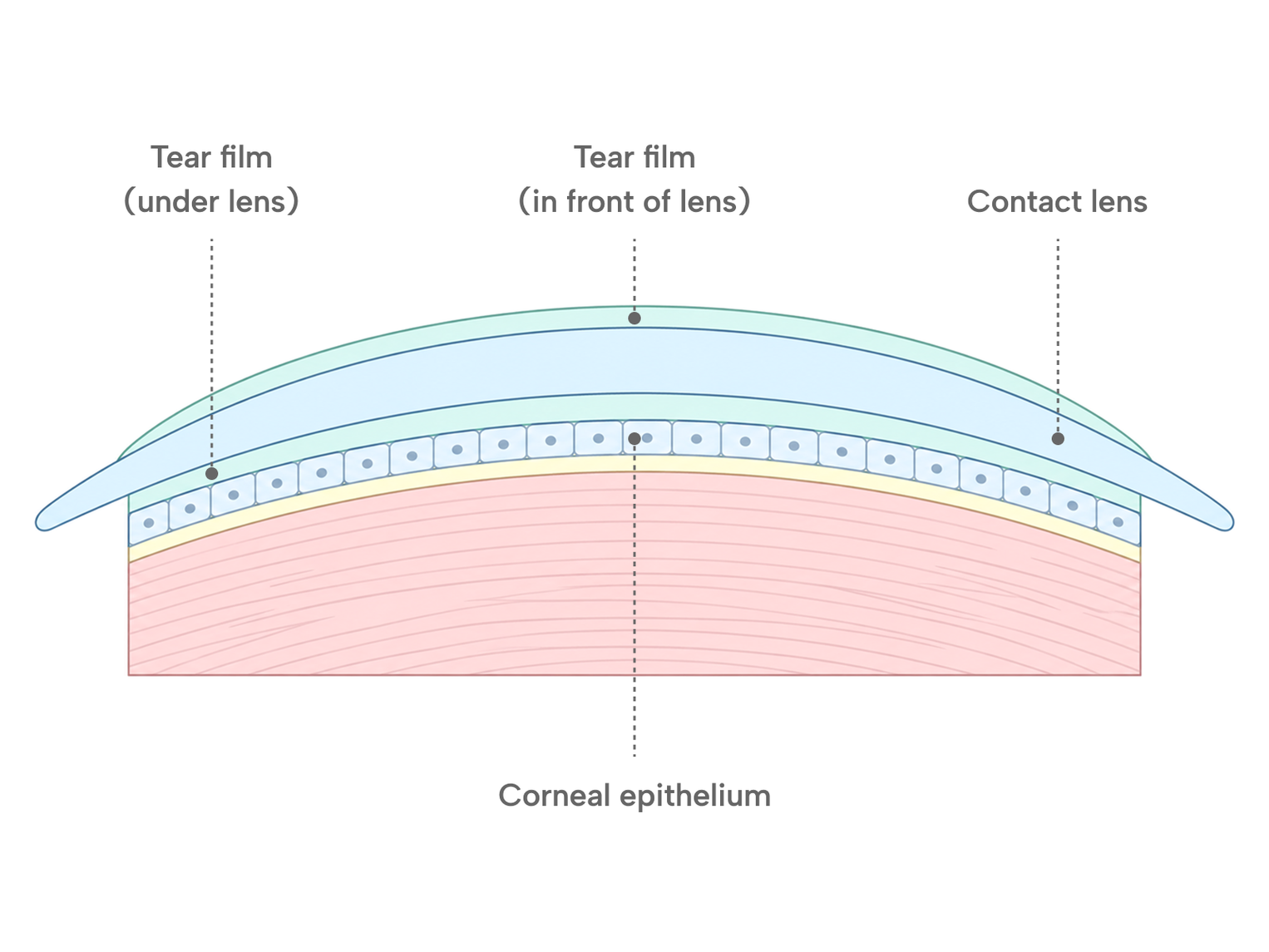
The cornea has no blood vessels of its own and gets much of the oxygen it needs from the tear film and the air in front of it. A contact lens rests within that tear film, which changes how oxygen reaches the corneal surface and how tears exchange underneath the lens. Reduced oxygen at the corneal surface and reduced tear exchange under the lens help explain several contact lens complications, in particular dryness, oxygen-related corneal changes, and some inflammatory reactions.
Two consequences follow. Closing the eyes reduces the oxygen available at the corneal surface, so a lens worn during sleep sits on a cornea that already has less oxygen than it does during the day. And the tear film in front of the lens thins faster than an unbroken tear film, which is why dryness and end-of-day fluctuating vision are common complaints among wearers. The inner surface of the upper eyelid also passes over the lens edge with every blink, which is the setting for the eyelid reactions described below.
What long-term or overnight wear can cause
Long-term and overnight contact lens wear is associated with three groups of problems: infection of the cornea, inflammatory and allergic reactions at the eyelid and ocular surface, and corneal changes linked to reduced oxygen. The groups differ in how quickly they appear and in whether the wearer notices them.
The table below sets out what is commonly reported to contact lens wearers and what signs are commonly reported for each.
What it is | Commonly reported signs | |
|---|---|---|
| Microbial keratitis (corneal infection) | An infection of the cornea, most often bacterial | Pain, marked redness, light sensitivity, discharge, reduced vision |
| Corneal neovascularization | Growth of new blood vessels into the cornea, associated with reduced oxygen at the corneal surface | May cause few symptoms early; usually identified on examination |
| Giant papillary conjunctivitis | An inflammatory reaction on the inner surface of the upper eyelid | Itching, mucus, the lens shifting out of position, shorter comfortable wearing time |
| Contact lens–related dryness | Reduced tear film stability during lens wear | Dryness, grittiness, vision that fluctuates late in the day |
| Corneal abrasion | A scratch on the corneal surface, sometimes from handling or a damaged lens | Sharp pain, tearing, foreign body sensation |
Figures for how often these occur are harder to pin down than the conditions themselves, and most published rates come from small or dated samples. One recent measurement is available for the severe end. In a Norwegian study of patients admitted to hospital with contact lens–related keratitis between 2018 and 2020, the yearly incidence among contact lens users over the age of 15 was 2.52 per 10,000 for extended-wear lenses used overnight. Among users of daily disposable lenses in the same study, the yearly incidence was 0.52 per 10,000. The study counted only cases severe enough to require hospital admission, so it does not describe milder infections managed in a clinic.
How long is too long to wear contact lenses
No single number defines how long is too long, because approved wearing schedules differ by lens and the schedule that applies to a wearer is set in the prescription. Wearing contacts too long usually means one of two things: keeping lenses in beyond the hours they were fitted for on a given day, or continuing to use a lens past its replacement interval.
Wearing lenses every day is a separate question from wearing them too long on any one day. Daily wear within the prescribed schedule is a recognised way to use lenses, and what changes with everyday wear is cumulative exposure rather than a single unsafe episode. Overnight wear is the pattern that guidance treats separately, and the CDC lists it among the risks for contact lens–related bacterial keratitis. The U.S. Centers for Disease Control and Prevention advises not sleeping in contact lenses unless an eye doctor has prescribed lenses for overnight use, and naps count as sleep for this purpose.
Important
Falling asleep in contact lenses reduces the oxygen reaching the cornea while the eyes are closed and lowers tear exchange under the lens. Unless the lenses were prescribed for overnight use, the CDC advises removing them before sleep.
Signs your eyes are not tolerating contact lenses
Certain symptoms during contact lens wear indicate that the lens should come out and stay out until an eye care professional has looked at the eye. The U.S. Food and Drug Administration lists these signs because a wearer cannot judge from symptoms alone how serious the underlying problem is.
The signs the FDA names are:
- Discomfort, or comfort that is worse than when the lens was first put in
- Excess tearing or other discharge
- Unusual sensitivity to light
- Itching, burning, or gritty feelings
- Unusual redness, swelling, or pain
- Blurred vision
The FDA also advises keeping the lenses rather than discarding them, since an eye care professional may want to examine them to identify the cause. Blurred vision that begins during lens wear is worth separating from blurred vision in one eye that appears without lenses, which has its own set of causes.
When to see a doctor
Eye pain, marked redness in one eye, sensitivity to light, discharge, excessive tearing, or blurred vision during contact lens wear are reasons to remove the lens, keep it out, and call an eye care professional immediately. The CDC gives this instruction for the symptoms of contact lens–related bacterial keratitis, and these symptoms are a reason to be examined rather than to wait and see whether they settle. If pain increases or vision drops further after the lens is out, treat that as more urgent, not less.
What lowers the risk for contact lens wearers
Most measures that reduce contact lens risk address the same two things: how long the lens stays on the eye, and what the lens and its case are exposed to between wears. The U.S. Centers for Disease Control and Prevention publishes the following habits for wearers.
- Wash and dry hands before handling lenses
- Avoid sleeping in lenses unless an eye doctor has prescribed them for overnight wear
- Avoid wearing lenses while showering, swimming, or using a hot tub, and keep lenses away from water in general
- For reusable lenses, rub and rinse them with disinfecting solution rather than water or saliva, and avoid storing lenses in water
- Replace lenses as often as the eye doctor directs, and replace the lens case at least every three months if a case is used
- For reusable lenses, use fresh disinfecting solution each time rather than adding new solution to old
- Visit an eye doctor once a year, or more often if advised
One reason water exposure carries a warning of its own is Acanthamoeba keratitis, a corneal infection caused by an organism found in water and soil. The U.S. Centers for Disease Control and Prevention describes this infection as rare, often very painful and difficult to treat, sometimes requiring a year or more of treatment, and advises removing lenses before showering or swimming.
Carrying a pair of glasses matters more than it first appears. The CDC includes this in its guidance because a wearer who has no alternative to a lens is more likely to keep wearing it after symptoms start.
When contact lenses stop working for someone
Some wearers reach a point where lens wear becomes uncomfortable enough that wearing time shortens or stops, and the reasons vary: changes in the tear film, an eyelid reaction that recurs, an eye condition unrelated to lenses, or a fit that no longer suits the eye. An eye examination is what separates these, since the management differs for each.
For wearers who cannot continue with lenses, glasses remain the standard alternative. Some people go on to ask whether refractive surgery is an option, and contact lens intolerance does not by itself make LASIK, surface ablation methods such as LASEK and PRK, or an implantable collamer lens suitable. Those procedures are separate medical decisions, each with its own eligibility criteria, side effects and recovery course, and eligibility is assessed by an ophthalmologist rather than decided from a list.
Medical information
This article is general medical information and is not a diagnosis or a treatment recommendation. Results vary by individual, and decisions about your own eyes should be made with an ophthalmologist.