LASIK recovery time is measured in two different ways, and confusing them causes most of the worry people feel in the first week. Functional recovery — seeing well enough to work, read, and move around — usually takes a day or two. Structural recovery, meaning the point at which the cornea has settled and vision stops shifting, takes closer to three months. Follow-up schedules and eye drop courses also differ between countries, so the general timeline comes first here and the Korean follow-up pattern after it.
Key takeaways
- Most people can see well enough for daily activities within 24 hours of LASIK, although vision is often hazy at first.
- Vision usually continues to sharpen over the first three months as the cornea settles.
- Dry eye is the most commonly reported symptom after LASIK and improves for most people within the first few months.
- Follow-up schedules differ between countries. In Korea, visits are commonly scheduled the day after surgery and again at roughly one week, one month, and three months.
What is the typical LASIK recovery time?
LASIK recovery happens in two stages. Most people reach usable vision within 24 hours and return to desk work after one to two days. The cornea then continues to stabilize for roughly three months, during which vision can fluctuate and dryness is common. Results vary by individual.
The reason for the two stages is anatomical. LASIK creates a thin flap in the outer cornea, and that flap settles back into position quickly, which is why sight returns fast. The corneal nerves cut during the procedure regenerate far more slowly, and their recovery is what drives the longer timeline for tear production and stable vision.
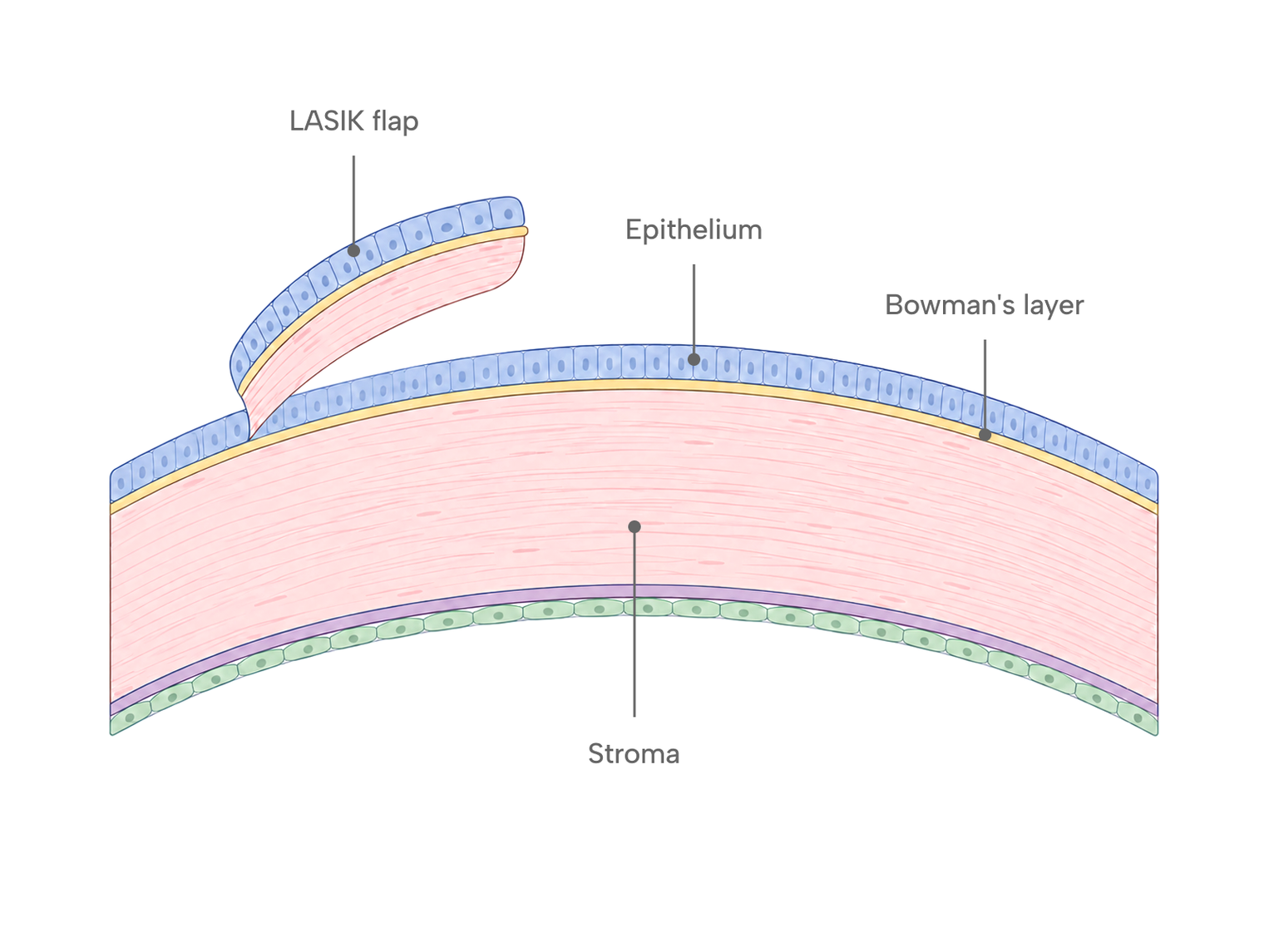
A small number of people continue to notice dryness or night-time glare beyond three months. Longer-lasting symptoms are less common but are not a sign that something has been done incorrectly. An eye doctor can assess whether treatment is needed.
LASIK recovery timeline: what to expect day by day
Recovery after LASIK is easiest to follow in four stages. The stages below describe what most people experience; individual healing differs, and a surgeon may give different instructions based on the eye examined.
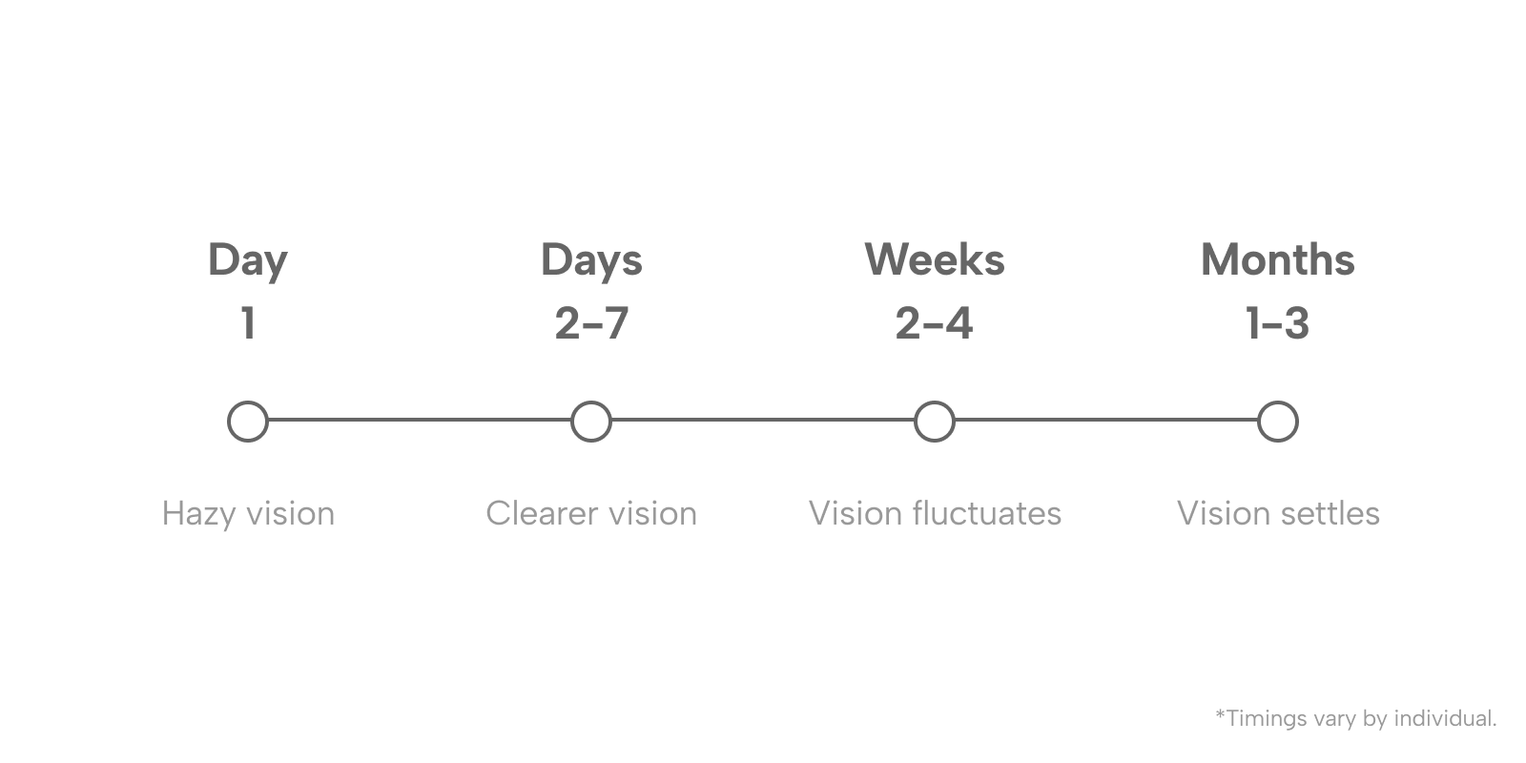
The first 24 hours
Vision is typically hazy or filmy immediately after surgery, similar to looking through a steamed window. Burning, watering, and light sensitivity are common for the first few hours and then ease. Most clinics ask patients to keep their eyes closed and rest for the remainder of the day rather than testing their new vision on a screen.
Prescribed eye drops usually begin the same day. Protective shields are generally worn during sleep so the eye is not rubbed unconsciously.
Important
Do not rub your eyes during the first week. The corneal flap created during LASIK seals into place rather than being stitched, and rubbing can shift it before it has settled. If your eye itches or feels gritty, use the drops your surgeon prescribed instead of touching the eye.
Days 2 to 7
Vision is usually clear enough for daily activities by the morning after surgery. Glare, starbursts, and halos around lights at night are common during this week and tend to reduce over the following weeks. Dryness and a mild gritty sensation are also typical.
Water is normally kept out of the eyes during this week, and eye makeup is postponed. Most people who work at a desk return to work during this period, using artificial tears more often than usual because blinking rates drop during screen work.
Weeks 2 to 4
Vision often fluctuates from day to day or between morning and evening during this stage. Mild corneal swelling can persist and resolve gradually over roughly three to four weeks, which explains why sight can seem sharper on some days than others.
Night-time halos usually continue to fade. Swimming pools, saunas, and public baths are generally avoided until around four weeks because of infection risk, and contact sports are usually restricted for a similar period or longer.
Months 1 to 3
Vision becomes steadier through this stage and dryness improves for most people. Night driving typically becomes more comfortable as glare reduces. In a multi-centre cohort of Korean patients, uncorrected visual acuity at three months was significantly better than at one month, which matches the pattern most people notice.
By the end of the third month, the refraction has usually settled enough for a surgeon to judge the outcome. Some people take longer, and dryness in particular can persist past this point in a minority of cases.
The table below groups the same four stages by what people usually notice, what is typically happening with follow-up and eye drops, and what is normally restricted.
What most people notice | Follow-up and drops | Commonly restricted | |
|---|---|---|---|
| Day 1 | Hazy vision; burning, watering, and light sensitivity for a few hours | Prescribed drops start the same day; shields worn for sleep | Screens; rubbing the eyes |
| Days 2–7 | Clearer vision; glare and halos at night; dryness | First post-operative examination; antibiotic and anti-inflammatory drops continue | Water in the eyes; eye makeup; rubbing the eyes |
| Weeks 2–4 | Vision fluctuates day to day; halos reduce | Further examination; artificial tears used as needed | Swimming; sauna and public baths; contact sports |
| Months 1–3 | Steadier vision; dryness improves for most people | Refraction usually settled enough to assess the outcome; artificial tears often continued | Most restrictions lifted; eye protection advised for contact sports |
When can you return to work, screens, and driving?
Most people who work at a desk return to work one to two days after LASIK. Jobs involving dust, chemicals, or physical contact usually require longer, and driving depends on how quickly vision and night-time glare settle. A surgeon confirms these timings at the follow-up examination rather than setting them in advance.
- Screen and desk work. Usually possible from the day after surgery. Screen use reduces blinking, which worsens dryness in the early weeks, so artificial tears and regular breaks are commonly advised. Some clinics suggest limiting heavy computer work during the first week.
- Physical, dusty, or outdoor work. Usually delayed longer because of the risk of debris or impact reaching the eye. Protective eyewear may be recommended after returning.
- Driving. Usually resumed once vision is confirmed at a follow-up visit, starting with daytime driving on familiar roads. Night driving is generally postponed until glare and halos have settled, which can take several weeks.
Good to know
Dryness during the first month is often worst during screen work, not during rest. If your vision blurs after an hour at a computer and clears after blinking, that pattern usually reflects tear film instability rather than a change in your prescription.
What can slow LASIK recovery down?
Several common effects can extend the period before vision feels settled. Most are temporary, and recognising them makes the timeline easier to interpret.
- Dry eye. The most frequently reported symptom after LASIK. Corneal sensitivity decreases for about three months after surgery, and the corneal nerves regenerate over roughly three to six months. Almost all patients experience some degree of dryness during this period, and a small number report symptoms that persist longer.
- Glare, halos, and starbursts at night. Common in the early weeks and usually reduce as the cornea settles. Higher pre-operative prescriptions are associated with more noticeable night-time symptoms.
- Fluctuating vision. Often linked to tear film instability rather than the correction itself, which is why dryness and blurred vision frequently improve together.
- Less common complications. Flap-related problems, inflammation under the flap, and infection are infrequent but documented, and most present within the first weeks. These are covered in more detail in our guide to LASIK side effects and complications.
Underlying conditions also matter. Dry eye that was already present before surgery is the strongest predictor of dryness afterwards, and long-term contact lens wear and larger corrections are also associated with more symptoms. An eye doctor assesses these before surgery rather than after.
When to see a doctor
Contact your eye clinic promptly if you have a sudden drop in vision, eye pain that is not relieved by your prescribed medication, a sharp increase in redness or discharge, flashes of light or a sudden increase in floaters, or vision that becomes clearly worse in one eye than the other. These symptoms need assessment rather than waiting for your next scheduled visit.
Who is generally not a candidate for LASIK?
Some eyes are not suitable for LASIK regardless of how well recovery would otherwise go. A prescription that is still changing, a cornea that is too thin or irregular for the planned correction, keratoconus, and certain autoimmune or corneal conditions are recognised contraindications. Pregnancy and breastfeeding are common reasons to postpone, since refraction can shift during these periods.
Suitability is decided by examination, not by prescription strength alone. An ophthalmologist assesses corneal thickness, corneal shape, tear film, and pupil size before recommending any procedure, and may suggest an alternative approach instead.
How long do LASIK results hold?
Vision usually stabilizes within the first three months, but the eye continues to change over years. In a three-year follow-up of LASIK procedures in a Korean population, myopic regression — a partial return of short-sightedness — occurred over time, and higher pre-operative prescriptions were associated with lower outcomes. Age-related near vision change, or presbyopia, develops independently of the surgery and typically becomes noticeable from the mid-forties.
Results vary by individual, and a follow-up examination is the only way to know how a specific eye has settled. What changes in the years afterwards is covered in how long LASIK results last.
How follow-up care works in Korea
Follow-up after LASIK in Korea is commonly scheduled around four points. Schedules vary by clinic and by how an individual eye is healing, and a surgeon may add visits. The schedule is front-loaded, with three of the four visits falling within the first month.
- The day after surgery
- At roughly one week
- At roughly one month
- At roughly three months
Eye drops usually fall into three groups. An antibiotic drop and an anti-inflammatory drop are prescribed for a defined course in the early weeks. Preservative-free artificial tears are used far longer — commonly through the first three months, and beyond that if dryness persists. Because the prescribed course is tied to the follow-up schedule, patients travelling home before the later visits should raise this at the first appointment so that drops and remote follow-up can be planned.
Activity guidance varies between clinics, and common instructions include: no rubbing and no water in the eyes for the first week, protective shields at night for about a week, eye makeup delayed by roughly two to three weeks, and swimming, saunas, and public baths avoided for about four weeks. Reported intervals differ, particularly for swimming and public baths, and the instructions given at discharge take precedence over general guidance.
Preparation before surgery also affects the schedule. Contact lenses must be stopped well before the measurement examination, because lens wear temporarily changes corneal shape. The required interval differs between lens types and between clinics, and it is longer for rigid lenses than for soft ones.
Medical information
This article is general information about laser vision correction and is not medical advice. Individual results differ. Decisions about whether a procedure is appropriate, and about follow-up care, should be made with a qualified ophthalmologist after examination.