Seeing clearly is not the same as having healthy eyes. Several common eye diseases develop without symptoms at first, so the right interval between comprehensive eye exams depends mainly on your age and risk factors rather than on how well you see. The recommended intervals come from published ophthalmology and diabetes guidelines, and an eye doctor may set a different interval after examining you.
Key takeaways
- Glaucoma, diabetic retinopathy and age-related macular degeneration can progress without early symptoms, so clear vision does not rule them out.
- For adults without symptoms or risk factors, the American Academy of Ophthalmology recommends a comprehensive eye exam every 5–10 years before age 40, every 2–4 years at 40–54, every 1–3 years at 55–64, and every 1–2 years from age 65.
- People with type 2 diabetes are advised to have a first eye exam at diagnosis, and people with type 1 diabetes within 5 years of diagnosis, usually followed by yearly exams.
- In Korea, optical shops measure lens power for glasses and contact lenses without using eye drops, while a dilated retinal exam is part of a medical eye evaluation.
- Sudden flashes of light, a burst of new floaters, a shadow over part of your vision, or intense eye pain with redness and nausea call for prompt care rather than waiting for a routine exam.
Why eye exams matter even when your vision seems fine
A comprehensive eye exam checks the health of the eye, not just how sharply you see. According to the National Eye Institute (NEI), many eye diseases have no symptoms or warning signs in their early stages, and widening the pupil with eye drops (dilation) lets an eye doctor check for conditions such as diabetic retinopathy, glaucoma and age-related macular degeneration.
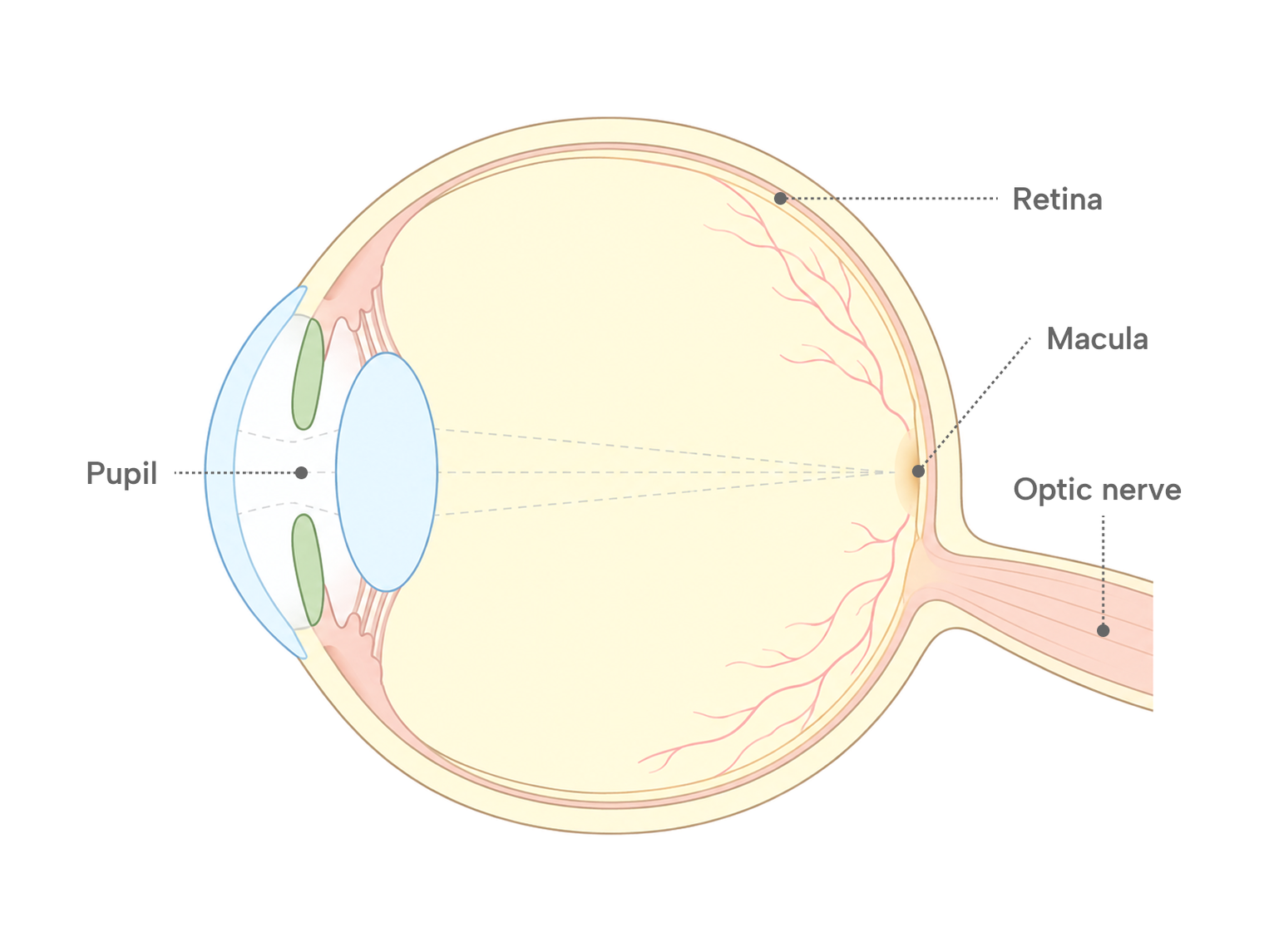
Glaucoma, a group of diseases that damage the optic nerve at the back of the eye, is a common example of an eye disease without early warning signs. NEI notes that glaucoma usually causes no symptoms at first and that about half of people with glaucoma do not know they have it. Early glaucoma treatment can often stop further damage, but it cannot restore vision that has already been lost. How glaucoma eventually shows itself is covered in early signs of glaucoma.
Diabetes-related eye disease can also be present without symptoms. The American Diabetes Association (ADA) notes that people with vision-threatening diabetic retinopathy may have no symptoms, which is why diabetes guidelines set separate eye exam timing for people with diabetes.
Recommended eye exam intervals by age
The American Academy of Ophthalmology (AAO) sets age-based intervals for comprehensive eye exams in its Comprehensive Adult Medical Eye Evaluation Preferred Practice Pattern, a clinical guideline for ophthalmologists. The AAO gives one set of intervals for adults with no symptoms and no known risk factors for eye disease, and a shorter set for adults with risk factors for glaucoma, such as diabetes, older age, a family history of glaucoma, and Black or Hispanic/Latino background.
The AAO recommends comprehensive eye exam intervals for adults by age group, with separate intervals for people without risk factors and people with glaucoma risk factors.
No risk factors | Glaucoma risk factors | |
|---|---|---|
| Under 40 | Every 5–10 years | Every 2–5 years |
| 40 to 54 | Every 2–4 years | Every 1–3 years |
| 55 to 64 | Every 1–3 years | Every 1–2 years |
| 65 and older | Every 1–2 years | Every 1–2 years |
The intervals shorten with age because the AAO guideline takes into account the rising risk of eye disease as people get older. The AAO also advises adults with no signs or risk factors for eye disease to have a comprehensive eye exam at age 40 if they have not had one before.
In Korea, the Korea Disease Control and Prevention Agency (KDCA, then known as the Korea Centers for Disease Control and Prevention) and the Korean Ophthalmological Society jointly published nine rules for eye health management. The rules advise adults aged 40 and older to have regular eye exams and children to have a vision test before age 4. The published summary of the nine rules gives no numeric interval for adults.
Note
The AAO’s age-based intervals apply to adults without symptoms. After each exam, an eye doctor may recommend a shorter or longer interval based on what the exam finds.
When you may need eye exams more often
Some eye conditions call for closer follow-up than the age-based intervals. The AAO notes that people with high myopia (severe nearsightedness) may need yearly retinal exams, and that an eye doctor sets the follow-up interval for anyone found to have risk factors or early signs of eye disease.
Diabetes has its own timing, because diabetic retinopathy (damage to the small blood vessels of the retina) can develop without early symptoms. The Korean Diabetes Association (KDA) and the ADA give similar recommendations for the first diabetes-related eye exam and for follow-up.
The Korean Diabetes Association recommends different timing for the first diabetes-related eye exam and for follow-up eye exams depending on the type of diabetes.
First eye exam | Follow-up eye exams | |
|---|---|---|
| Type 1 diabetes | Within 5 years of diagnosis | Yearly; every 1–2 years may be considered if no retinopathy is found and blood sugar is well controlled |
| Type 2 diabetes | At diagnosis | Yearly; every 1–2 years may be considered if no retinopathy is found and blood sugar is well controlled |
| Existing diabetes and pregnancy | Before pregnancy, and within the first 3 months of pregnancy | Checks during pregnancy and up to 1 year after birth, depending on findings |
For people with existing diabetes who become pregnant, the KDA suggests eye checks about every 3 months during pregnancy and for 1 year after birth. Diabetes that first appears during pregnancy (gestational diabetes) is different: the ADA states that people who develop gestational diabetes do not need eye exams during pregnancy, because they do not appear to be at increased risk of diabetic retinopathy during pregnancy.
Some situations sit outside the routine intervals. If you are considering LASIK, the eye tests done before surgery are explained in how to prepare for LASIK. Long-term contact lens wear raises separate questions about the surface of the eye, covered in long-term contact lens wear.
How eye exams and national health screening work in Korea
The AAO’s recommended intervals refer to comprehensive eye exams. In Korea, vision is also measured at optical shops and during national health screenings, but neither counts as a comprehensive eye exam.
In Korea, eye care is split between ophthalmology clinics (angwa) and optical shops (angyeongwon). Under Korea’s Medical Service Technologists, etc. Act, licensed opticians at optical shops perform refraction to set the power of glasses and contact lenses without using eye drops. The Act’s Enforcement Decree also requires a doctor’s prescription for glasses or contact lenses for children aged 6 and under.
A dilated retinal exam uses eye drops and is part of a comprehensive medical eye evaluation, so a lens measurement at a Korean optical shop is a test for fitting glasses or contact lenses rather than a check of eye health such as eye pressure or the retina. The AAO guideline draws the same line, treating refractions and glasses or contact lens evaluations as interim vision checks rather than comprehensive medical eye evaluations.
Korea’s national general health screening includes a visual acuity test and a hearing test. The listed screening items, including those added at specific ages, do not include an eye pressure check or a retinal exam, so a normal result on that vision test does not replace a comprehensive eye exam.
Korea’s national infant and child health screening covers ages 14 days to 71 months in eight visits. The checkups include a questionnaire about vision, and a visual acuity test is done at 42, 54 and 66 months.
The table compares what Korea’s national health screening and U.S. guidance say about eye checks for adults without symptoms and for young children.
Korea | United States | |
|---|---|---|
| Adults without symptoms | General health screening includes a visual acuity test; the listed items do not include an eye pressure check or a retinal exam | The U.S. Preventive Services Task Force found the evidence insufficient to assess the balance of benefits and harms of screening for primary open-angle glaucoma in adults 40 and older without symptoms |
| Young children | National infant and child health screening has eight visits from 14 days to 71 months, with a visual acuity test at 42, 54 and 66 months | The American Academy of Ophthalmology and the American Association for Pediatric Ophthalmology and Strabismus advise eye checks at well-child visits in early childhood, formal visual acuity testing by age 5, and screening every 1–2 years after age 5 |
The U.S. Preventive Services Task Force (USPSTF) statement covers glaucoma screening in primary care settings. The AAO intervals for comprehensive eye exams are a separate set of guidance.
Symptoms that should not wait for your next eye exam
Routine intervals are designed for people without symptoms. New eye symptoms are a reason to see an eye doctor regardless of when the last exam took place.
Some symptoms point to conditions that need prompt treatment. According to NEI, a sudden increase in floaters, flashes of light, or a curtain-like shadow over part of your vision can be signs of retinal detachment, and intense eye pain with nausea, a red eye and blurry vision can be signs of angle-closure glaucoma. The common causes of floaters are explained in eye floaters, and one-sided blurring and eye redness are covered in blurry vision in one eye and bloodshot eyes.
When to see a doctor
If you notice a sudden burst of new floaters, flashes of light, a shadow or curtain over part of your vision, or intense eye pain with nausea, redness and blurred vision, see an eye doctor or go to an emergency department right away rather than waiting for a routine exam.
Medical information
General health information cannot replace an eye examination. Recommended intervals and results vary by individual, and the right timing for your eye exams should be decided with an ophthalmologist.