LASEK and PRK reshape the cornea without creating a flap. Both remove the epithelium, the cornea's outermost layer of cells, so that an excimer laser can reshape the tissue underneath. They differ in what happens to that epithelial sheet afterwards: LASEK returns it to position, PRK removes it and lets a new one grow. Korean public health guidance groups the two under a single heading, surface ablation, and notes that the Korean term for LASEK is sometimes used for both.
Key takeaways
- LASEK and PRK both remove the corneal epithelium before the laser reshapes the stroma, and neither creates a flap.
- The difference between them is what happens to the epithelium afterwards — LASEK returns it, PRK lets it regenerate.
- Re-epithelialisation takes about three to five days, during which a bandage contact lens is worn, and vision continues to sharpen for weeks afterwards.
- In Korea the two are grouped under surface ablation, and the Korean term for LASEK is sometimes used for both.
What is LASEK?
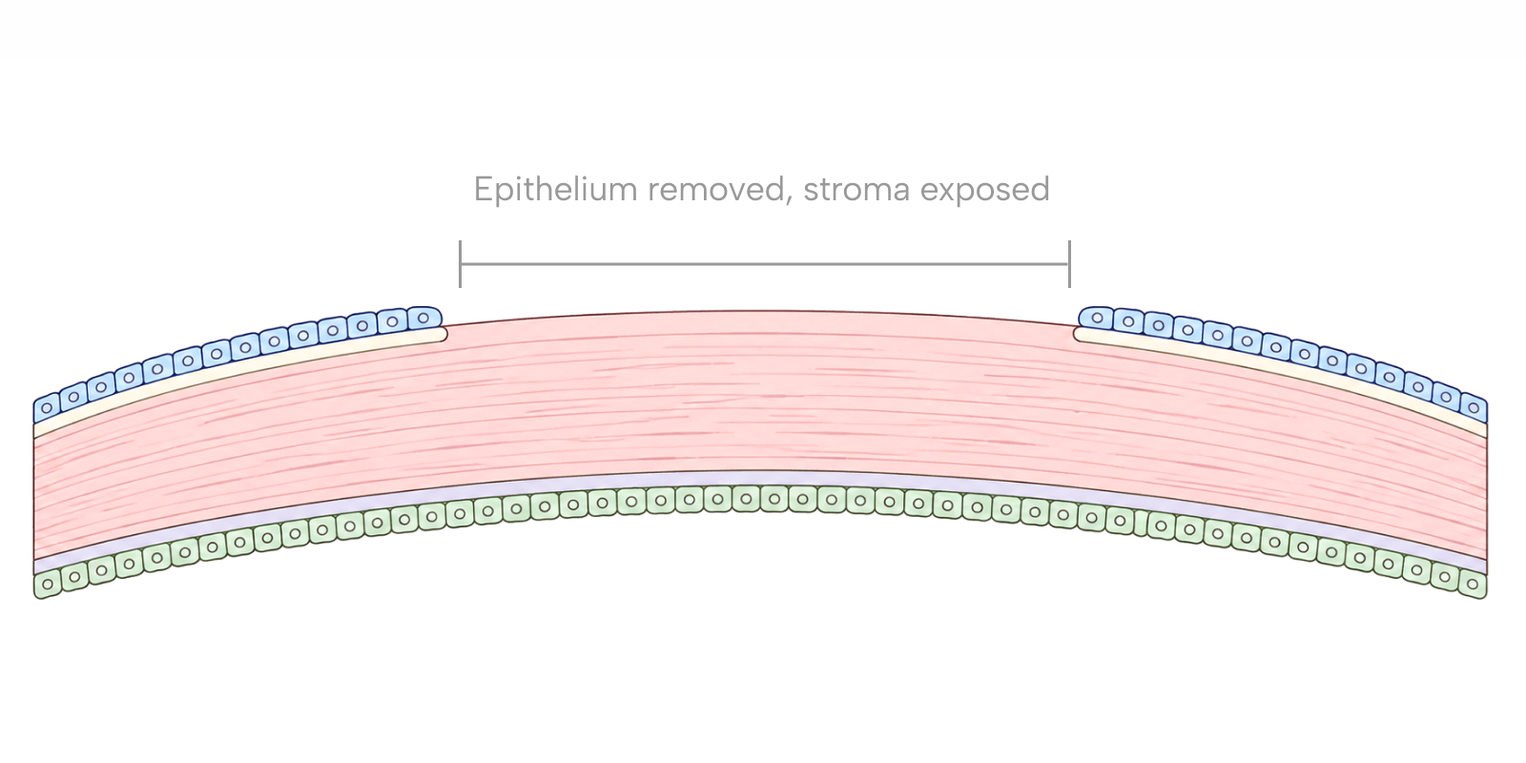
LASEK stands for laser epithelial keratomileusis. The surgeon loosens the epithelium — the cornea's outermost layer of cells — and lifts it as a thin sheet rather than removing it. An excimer laser then reshapes the stromal tissue underneath to correct the refractive error, and the epithelial sheet is placed back over the treated surface. No corneal flap is created at any point.
PRK, or photorefractive keratectomy, follows the same sequence with one difference: the epithelium is removed rather than replaced, and a new layer grows in over the following days. Both procedures are classified as surface ablation because the laser works at the surface of the stroma rather than beneath a flap.
Both approaches rely on the epithelium being able to close over the treated area — by being replaced in LASEK, or by regenerating in PRK. The reshaping done to the stroma underneath does not regrow in the same way.
How the procedure is performed
Surface ablation follows four steps.
- Anaesthetic drops. The eye is numbed with drops rather than an injection.
- The epithelium is opened. In LASEK the loosened sheet is lifted and kept; in PRK it is removed. Korean public health guidance describes a surgical blade, alcohol or a laser as the means of separating it, without tying any one of them to a single technique.
- The laser reshapes the stroma. An excimer laser removes tissue according to a pattern calculated from the pre-operative measurements.
- A bandage contact lens is placed. It protects the surface while the epithelium settles or regrows, and it is removed at a follow-up visit once that is complete.
The surgeon may apply mitomycin C to the treated surface during the procedure. It is used to reduce the chance of corneal haze developing afterwards. Whether it is applied is a decision the surgeon makes for the individual eye rather than a routine step in every case.
What the pre-operative examination measures
Suitability for surface ablation is decided by measurement rather than by prescription strength. Several of these measurements are the same ones taken before any refractive procedure, and a few carry particular weight here.
- Corneal shape mapping. Identifies irregular patterns across the cornea, including early keratoconus that has not yet affected vision.
- Corneal thickness. Establishes how much tissue is present and how much would remain after the planned treatment.
- Higher-order aberrations. Optical irregularities that are associated with glare and halos at night. They are measured as part of the assessment.
- Pupil size. Measured in dim light. Larger pupils in low light have been associated with more night-time visual symptoms after refractive surgery.
- Intraocular pressure. Korean public health guidance lists suspected glaucoma among the reasons a refractive procedure would not be recommended, and pressure measurement is part of screening for it.
- Fundus examination. Checks the retina and optic nerve for conditions that would affect vision independently of the cornea.
No single measurement decides the outcome on its own. The findings are read together, and one of them can be enough to rule an eye out.
Good to know
Because surface ablation creates no flap, the amount of tissue the treatment has to work with is calculated differently than it is for a flap-based procedure. An eye assessed for one is therefore measured again rather than assumed to qualify for the other.
Who is assessed for surface ablation
A cornea with scarring, an irregular astigmatism that the laser cannot correct predictably, keratoconus or progressive ectasia, and a prescription that is still changing are all reasons the procedure would not be recommended. Korean public health guidance sets the minimum age at 18 and requires that the prescription has not been changing over the preceding year.
Untreated dry eye, active inflammation or infection in the eye, and certain autoimmune conditions are assessed, as are pregnancy and breastfeeding. Korean guidance adds two further categories: being unable to attend follow-up appointments, which matters for anyone travelling, and holding expectations of the result that the procedure cannot meet.
Because no flap is created, the tissue calculation differs from LASIK. Some eyes that are not suitable for a flap-based procedure may still be assessed for surface ablation, which is one reason the procedure remains in regular use rather than having been superseded. Corneal thickness, corneal shape and the risk of ectasia still determine suitability. Who is generally suitable for corneal refractive surgery is covered in LASIK side effects and complications.
LASEK and LASIK: what differs
Both use an excimer laser to reshape the stroma, and both aim at the same result. What differs is how the laser reaches that tissue and what happens to the layers above it.
The table below compares the two procedures on what physically happens to the cornea, rather than on outcomes.
LASIK | LASEK and PRK | |
|---|---|---|
| Corneal flap | Created and folded back | Not created |
| Epithelium | Lifted with the flap and returns with it | Lifted and replaced in LASEK; removed and regrown in PRK |
| Where the laser works | On the stroma exposed under the flap | On the stroma exposed at the surface |
| After the procedure | The flap settles back into position | A bandage contact lens covers the surface |
| Early healing | The flap seals | The epithelium settles or grows back over the treated area |
| Refractive errors treated | Short-sightedness, long-sightedness and astigmatism | Short-sightedness, long-sightedness and astigmatism |
| Corneal thickness | Assessed for a flap plus the treatment | Assessed differently because no flap is created |
What recovery involves, and what to plan for
Recovery after surface ablation is organised around the epithelium settling or growing back. Re-epithelialisation takes roughly three to five days, and the bandage contact lens stays in place until that is complete. Discomfort, a gritty sensation, watering and light sensitivity are common during this period, and prescribed drops are used to manage them. Korean public health guidance describes pain lasting around four to five days after surface ablation, attributing it to the removal of the corneal epithelium.
Vision is commonly blurry while the surface is still smoothing out, and it improves as the epithelium settles. Reported timeframes for visual recovery vary; several accounts place it at around three to four weeks, with refraction continuing to stabilise for one to three months.
Corneal haze — a clouding of the treated surface — is one of the complications most closely associated with surface ablation. It is generally reported within the first year. Mitomycin C applied during surgery has been described as reducing the risk of it developing.
Before surgery, the main thing to plan for is stopping contact lens wear. Lenses temporarily change the shape of the cornea, so measurements taken too soon after removal do not reflect the eye's actual state. Korean public health guidance specifies at least one week for soft lenses and at least three weeks for rigid lenses. Reported intervals vary, and some clinics work with shorter ones, so the figure that applies is the one given by the clinic performing the surgery.
Afterwards, the bandage contact lens shapes what the early restrictions focus on. It stays in place until the epithelium has closed over, which is why it is not removed at home and why water is kept out of the eyes during that period. When screens, washing, exercise and eye makeup are resumed is set by the clinic. LASIK recovery time sets out the general pattern week by week, and preparing for laser eye surgery covers the examination requirements and travel timing in more detail.
Important
Do not remove or rub at the bandage contact lens. It is protecting a surface that has had its outer layer opened, and disturbing it can interrupt healing. Your surgeon removes it once the epithelium has closed over. If it falls out on its own, contact the clinic rather than replacing it yourself.
When to see a doctor
Contact your eye clinic promptly if pain increases rather than easing after the first few days, if the bandage contact lens dislodges, if you have a sudden drop in vision, or if redness or discharge increases sharply. The surface remains open until the epithelium closes over it, which makes early symptoms worth reporting rather than waiting out.
Surface ablation in Korea: what the names cover
In Korea, PRK and LASEK are grouped under the single heading of surface ablation, even though the techniques are distinguished from one another. Public health guidance describes both as removing the corneal epithelium before the excimer laser reshapes the stroma, and separates them by what happens to that epithelial sheet: PRK removes it, LASEK returns it to its original position. The same guidance notes that the two are now sometimes referred to collectively by the Korean term for LASEK.
The name alone may not tell you which technique is planned. Asking whether the epithelium will be put back after treatment, or left to grow back on its own, identifies it directly.
An older Korean health technology assessment, based on data reported in 2010, followed 2,638 patients over three years. Among eyes treated with surface ablation, 90.3% retained uncorrected vision of 0.5 or better at the three-year mark, and myopic regression — refraction dropping by more than 10% from the three-month measurement — was recorded in 8.6% at one year and 13.5% at three years. Corneal haze was reported in 7.7%, mostly within the first year. The haze figure should be read as historical data, since surface-ablation technique and haze prevention have both changed since it was collected.
What surface ablation does not correct
Surface ablation reshapes the cornea, which means it changes how light is focused. It does not treat problems that arise in the lens, the retina or the optic nerve. Age-related near vision change, or presbyopia, develops in the lens inside the eye and is not affected by reshaping the corneal surface. Having LASEK does not change when that shift begins.
Cataract, glaucoma and retinal conditions develop independently of any corneal procedure and on their own timescale. How long LASIK results last covers the same question for corneal reshaping in general.
Approved treatment ranges are set by each regulator, so the prescriptions a procedure can address depend on where the surgery is performed. An examination establishes what applies to a specific eye.
Medical information
This article is general information about laser vision correction and is not medical advice. Individual results differ. Decisions about whether a procedure is appropriate, and about follow-up care, should be made with a qualified ophthalmologist after examination.