LASIK side effects fall into two groups that are easy to confuse. The first group is common and temporary — dryness, glare around lights at night, and vision that shifts from day to day. The second group is uncommon and may need treatment. This article covers how often each occurs, what the evidence says about vision loss, and why symptoms sometimes persist.
Key takeaways
- Nearly half of participants in the U.S. Food and Drug Administration's PROWL studies reported at least one new visual or dry eye symptom three months after LASIK.
- Overall symptom rates were still lower after surgery than before it, because many participants already had symptoms before surgery.
- Dissatisfaction with vision was reported by 1% to 4% of PROWL participants.
- In Korea, screening before refractive surgery commonly includes a genetic test for a corneal dystrophy that is more common in Koreans than in most other populations.
What are the most common side effects of LASIK?
The most common side effects of LASIK are dry eye, night-time glare and halos, and vision that fluctuates during the day. These affect a substantial share of patients in the first months and settle for most people. Less common problems, including flap displacement, infection, and corneal ectasia, are reported far less often than questionnaire symptoms but need prompt treatment.
Other issues are also documented, including under- or over-correction, regression, inflammation under the flap, epithelial ingrowth, and persistent ocular pain. This article covers the side effects most often asked about and those for which population-level estimates are available.
Important
Do not judge a symptom by how alarming it feels. Mild discomfort in the first days is expected, while a sudden change in vision is not, and the two can feel similar to someone who has never had eye surgery. If you are unsure whether something is normal, contact your eye clinic rather than waiting to see whether it improves.
The table below shows how often each side effect has been reported, what typically happens to it, and what is known about symptoms that do not settle.
How often it is reported | What usually happens | If it persists | |
|---|---|---|---|
| Dry eye | About 28% of people with no dry eye symptoms before surgery reported some at three months | Improves over the first months as corneal nerves recover | Treatable in most cases; assessment identifies whether another cause is involved |
| Glare, halos, and starbursts | Counted together with dry eye, 43% to 46% of PROWL participants reported at least one new symptom at three months | Reduces as the cornea settles | Higher pre-operative prescriptions are associated with more noticeable night-time symptoms |
| Fluctuating vision | Common in the early weeks | Often improves alongside dryness, since tear film instability is a frequent cause | Refraction is reassessed once the cornea has stabilized |
| Flap displacement or folds | Repositioning was needed in about 0.35% of eyes in a series of 21,536 femtosecond LASIK procedures | Corrected by repositioning, usually with good visual recovery | Early treatment is associated with better outcomes than delayed treatment |
| Loss of two or more lines of vision | About 66 per 10,000 eyes in a 2020 pooled analysis | Uncommon | Requires specialist assessment |
Are LASIK side effects permanent?
For most people, LASIK side effects are temporary rather than permanent. Dryness, glare, and fluctuating vision improve for the large majority during the first three to six months, as the cornea stabilizes and the corneal nerves regenerate. A minority report symptoms that continue beyond that period.
The PROWL studies show the pattern clearly. Among participants with normal ocular surface scores before surgery, a substantial proportion had some dry eye symptoms at three months. At the same time, the overall proportion of participants with normal scores rose from 55% before surgery to 66% at three months and 73% at six months in one study group. Both facts are true: new symptoms appeared in people who had none, while the group as a whole was drier before surgery than after it.
Dry eye that was already present before surgery is the strongest predictor of dryness afterwards. Larger corrections and long-term contact lens wear are also associated with more symptoms. This is why the pre-operative examination assesses tear film rather than prescription alone.
For the week-by-week course of normal recovery, see our guide to LASIK recovery time.
How often do LASIK complications happen?
Serious complications after LASIK are uncommon, and the figures depend on what is being counted. Symptoms reported by patients on questionnaires are measured in tens of percent. Complications requiring surgical intervention are measured in fractions of a percent. Confusing the two is the main reason published "complication rates" appear to disagree.
Three findings from the FDA's PROWL studies give the clearest picture of the patient-reported end. Of 534 participants who underwent LASIK, 43% in one study group and 46% in the other reported at least one new visual or dry eye symptom at three months. Dissatisfaction with vision ranged from 1% to 4%, and dissatisfaction with the surgery itself from 1% to 2%. The studies also found that participants were more likely to report symptoms on a self-administered questionnaire than directly to their clinician.
At the surgical end, a series of 21,536 femtosecond LASIK procedures found that flap repositioning was needed in about 0.35% of eyes, most often for flap folds or displacement within the first two weeks. Rarer still is corneal ectasia, the most serious complication specific to the procedure, which occurred in 0.02% of eyes in an audit of 53,731 procedures.
Good to know
A high symptom rate and a high satisfaction rate can both be true at once. In the PROWL studies, new symptoms and high satisfaction were reported at the same time, and dissatisfaction with the surgery stayed between 1% and 2%. Rates of new symptoms describe how many people noticed something, not how many were bothered by it.
Can LASIK cause blindness?
LASIK carries a risk of vision loss, and clinical studies measure it as partial loss rather than total. The standard measure is losing two or more lines of best-corrected vision, which occurred in approximately 66 per 10,000 eyes in a 2020 pooled analysis of contemporary LASIK. The studies cited here report that partial measure rather than complete blindness as an outcome.
The same analysis compared this with contact lens wear, which also carries a risk of vision loss through microbial keratitis. It estimated that the risk of vision loss from LASIK is comparable to the cumulative risk from wearing soft daily disposable contact lenses over roughly a century. The comparison is useful because most people considering LASIK are already contact lens wearers and are weighing one risk against another rather than against zero.
Severe outcomes, where they occur, generally follow one of two paths: infection that is not treated early, or corneal ectasia in an eye that was not suitable for the procedure. Both are reasons why the pre-operative examination and the follow-up schedule exist.
What increases the risk of LASIK side effects?
Several factors are associated with a higher chance of side effects, and an ophthalmologist assesses them before surgery rather than afterwards.
- Dry eye before surgery. The strongest predictor of dryness afterwards. Existing dry eye is usually treated first, and in some cases it changes which procedure is recommended.
- Higher prescriptions. Larger corrections are associated with more night-time glare and halos, and with a greater chance of residual refractive error.
- Autoimmune and corneal conditions. Can affect healing and may make the procedure unsuitable.
- Age over 50. Associated with a higher rate of flap-related complications in at least one large series.
Symptoms that continue past the expected recovery period deserve assessment rather than patience. Persistent dryness, glare, and fluctuating vision are uncommon but real, and many have identifiable causes that can be treated — tear film problems, residual refractive error, or an unrelated eye condition among them. Waiting does not improve the odds, and an examination can distinguish between a symptom that is still settling and one that needs intervention. SMILE eye surgery is covered in a separate guide as a corneal laser procedure with a different incision and tissue-removal pattern from LASIK.
When to see a doctor
Arrange an eye examination if dryness, glare, or blurred vision has not improved over several months, if a symptom that was improving starts to worsen, or if your vision is clearly better on some days than others long after the expected recovery period. Persistent symptoms are worth investigating rather than waiting out, and an examination can identify causes that respond to treatment.
What is corneal ectasia, and how is it screened for?
The reason corneal measurements carry more weight than prescription strength is corneal ectasia. In ectasia the cornea progressively thins and bulges forward after surgery, distorting vision and sometimes requiring further treatment. It is uncommon, and the eyes most at risk can usually be identified beforehand rather than after symptoms appear.
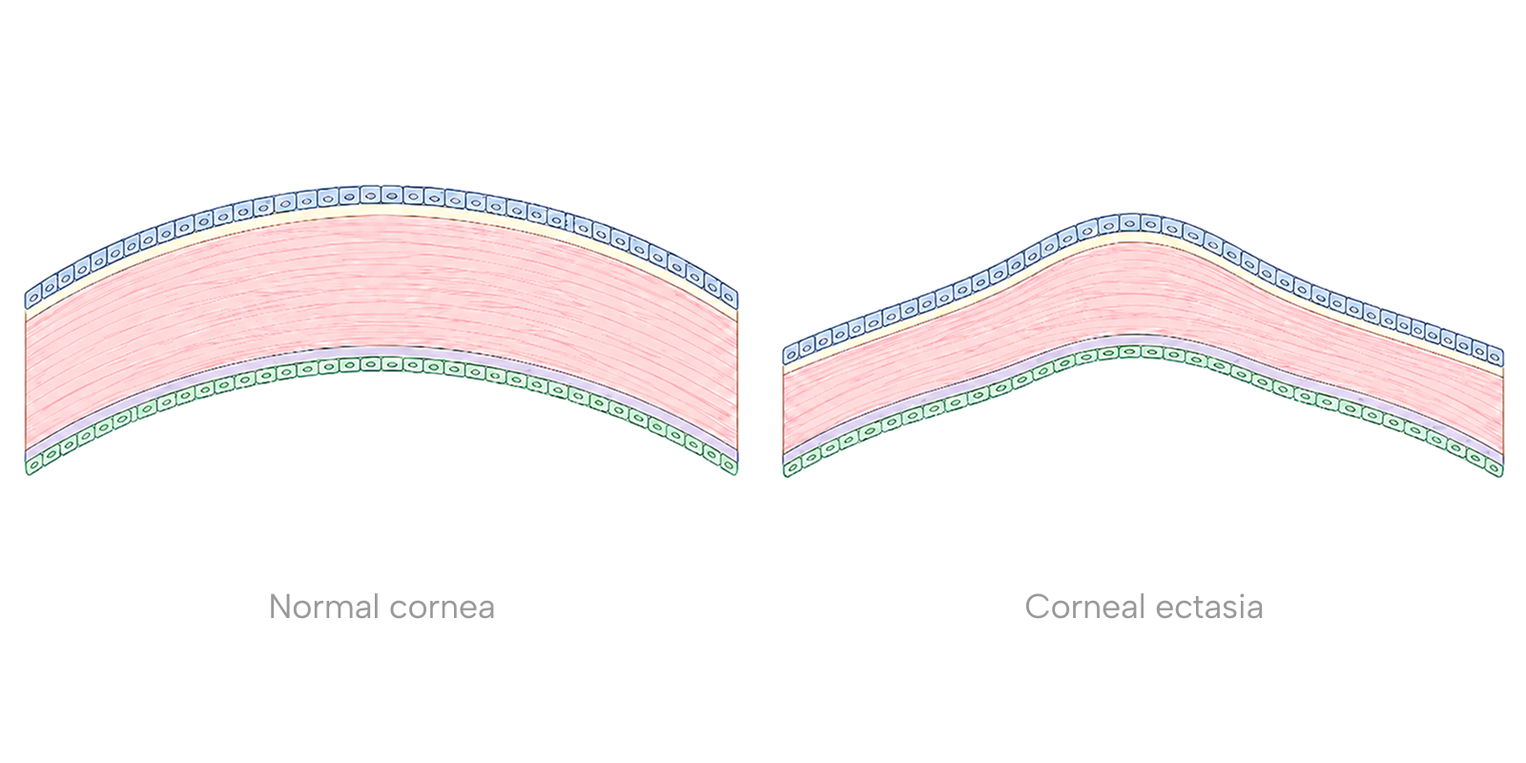
Three measurements do most of that work. Corneal thickness determines how much tissue can be removed while leaving enough underneath. Corneal shape mapping identifies irregular patterns, including early keratoconus that has not yet affected vision. The residual stromal bed — the tissue left beneath the flap after treatment — is calculated in advance and has an accepted minimum. An eye that falls outside these limits is usually advised toward a different procedure, or toward none.
Why refractive surgery screening in Korea includes a genetic test
Screening before refractive surgery in Korea has been described as commonly including a genetic test that is not routine in most other countries. The test looks for a variant in the TGFBI gene associated with granular corneal dystrophy type 2, a condition in which corneal opacities worsen sharply after laser surgery. In other settings the same test is more often used selectively, or to confirm a suspected clinical diagnosis.
The reason is population genetics. A 2025 analysis of 129,933 Koreans estimated the prevalence of granular corneal dystrophy type 2 at approximately 1 in 491, which is higher than estimates for most other populations. A higher carrier rate means a higher number of people for whom laser refractive surgery is contraindicated, which is why screening is applied before surgery rather than after symptoms appear.
For a reader having surgery in Korea, this appears as an additional test during the pre-operative examination. It does not change the procedure itself, and a negative result does not remove the other contraindications an ophthalmologist checks for.
Medical information
This article is general information about laser vision correction and is not medical advice. Individual results differ. Decisions about whether a procedure is appropriate, and about follow-up care, should be made with a qualified ophthalmologist after examination.