SMILE, or small incision lenticule extraction, corrects short-sightedness by removing a thin disc of tissue from inside the cornea. The tissue is taken out through an incision of a few millimetres, so no corneal flap is created. That single structural difference explains most of what sets the procedure apart from LASIK, including what it can treat and where its limits lie.
Key takeaways
- SMILE removes a disc-shaped piece of corneal tissue, called a lenticule, through a small incision rather than lifting a flap.
- Approved treatment ranges are set by each regulator. In the United States the approval covers short-sightedness from -1.00 to -10.00 dioptres and astigmatism from -0.75 to -3.00 dioptres, in people aged 22 and over.
- Long-sightedness and age-related near vision change are outside what this procedure addresses; near vision change originates in the lens rather than the cornea.
- Reported complication rates vary between studies, partly because definitions, surgical experience, and the manual lenticule-extraction step differ.
What is SMILE eye surgery?
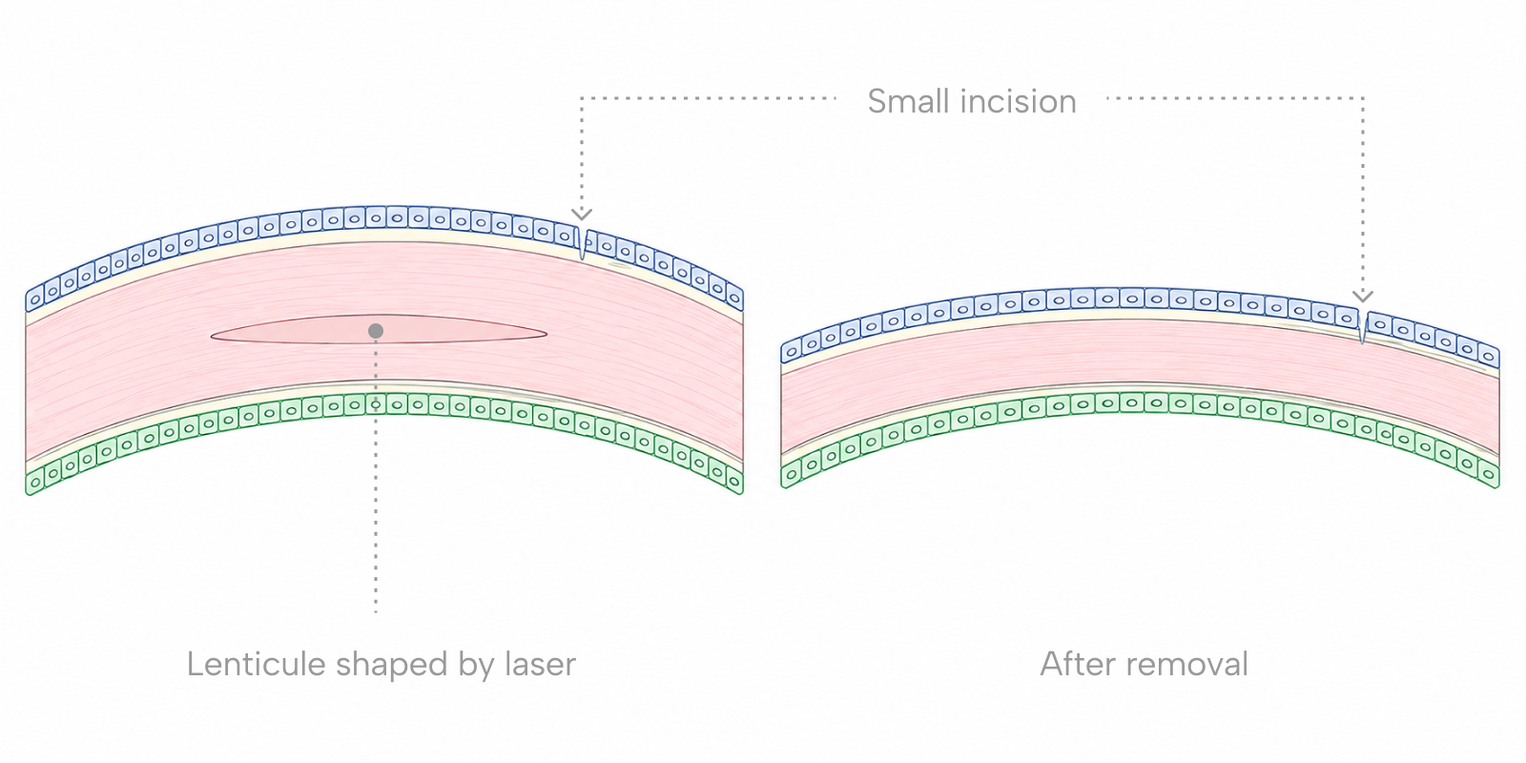
SMILE stands for small incision lenticule extraction. A femtosecond laser shapes a thin, disc-shaped piece of tissue inside the cornea, called a lenticule, and also creates a small incision at the corneal surface. The surgeon then removes the lenticule through that incision. Taking the tissue out changes the curvature of the cornea, which is what corrects the refractive error.
Unlike LASIK, the procedure does not create a broad corneal flap. The laser reaches the lenticule by passing through the outer layers rather than folding them back, and the tissue is then removed through the surface incision, which is a few millimetres across and closes on its own.
The procedure was approved by the U.S. Food and Drug Administration in 2016 for short-sightedness, with the approved range extended to include astigmatism in 2018. Some clinics use newer-generation laser systems and refer to them by different product names, but the underlying principle is the same in each case.
Published outcomes give a sense of what the procedure achieves. In a series of 405 eyes followed for twelve months, 79% reached uncorrected distance vision of 20/20 or better and 99% reached 20/40 or better, with no eye losing two or more lines of best-corrected vision. Individual results differ, and an examination is what determines what a specific eye can expect.
How does SMILE differ from LASIK?
The clearest difference is structural. LASIK works under a hinged flap; SMILE works through a small incision and makes no flap at all. Both procedures end with a cornea of altered curvature, and they arrive there differently.
The absence of a flap has consequences that run through the rest of this article. Because there is no flap, there is no flap to displace afterwards, but there is a manual step — separating and withdrawing the lenticule — that LASIK does not have. Because the outer layers stay largely intact, the surface heals differently. And because the correction depends on cutting a lenticule of a calculated thickness, the range of prescriptions the procedure can treat is defined differently.
The table below compares the three procedures on what physically happens to the cornea and on which refractive errors each addresses, rather than on outcomes. PRK is included because it also creates no flap, which makes the point at which the three diverge easier to see.
LASIK | PRK/LASEK | SMILE | |
|---|---|---|---|
| Corneal flap | Created and folded back | Not created | Not created |
| Epithelium | Lifted with the flap and returns with it | Removed, then regenerates over days | Left in place apart from the incision |
| Where the laser works | On the stroma exposed under the flap | On the stroma exposed at the surface | Inside the stroma |
| How tissue is removed | Vaporised by the laser | Vaporised by the laser | Withdrawn as a single disc |
| What remains after surgery | A hinged flap that settles back into position | An exposed surface that re-epithelialises | The surface incision |
| Refractive errors treated | Short-sightedness, long-sightedness and astigmatism | Short-sightedness, long-sightedness and astigmatism | Short-sightedness and astigmatism |
| Retreatment | The existing flap can be lifted | Usually further surface ablation | No flap to lift; the approach differs |
Two of the three create no flap at all, so that is not where they diverge. The difference is which layer of the cornea the laser works in. PRK and LASEK, which treat the surface after removing the epithelium, are covered separately in our guide to PRK and surface ablation.
What does recovery look like after SMILE?
Because no flap is created, the early restrictions after SMILE centre on the incision rather than on flap position. Vision is typically usable within the first day or two, and eye drops are prescribed for a defined course. As with any corneal procedure, the eye is not rubbed during the early period and water is kept out of it.
Dryness, fluctuating vision, and glare around lights at night can occur during the first months as the cornea settles. These are common to corneal refractive surgery generally rather than specific to SMILE, and they ease for most people. An eye doctor assesses symptoms that continue beyond the expected period rather than waiting them out.
Follow-up visits are scheduled to check that the refraction is settling and that the incision is healing. The week-by-week course of corneal refractive-surgery recovery is covered in more detail in our guide to LASIK recovery time. The two procedures affect the cornea differently, so the specific instructions and their timing come from the surgeon who performed the operation.
Important
Do not rub your eyes in the weeks after surgery. Although SMILE does not create a flap, the incision and the tissue around it are still healing, and the cornea remains more vulnerable to mechanical force than usual. If your eye itches or feels gritty, use the drops your surgeon prescribed instead of touching the eye.
What complications are reported after SMILE?
Many SMILE-specific complications relate to the step that replaces the flap: separating and withdrawing the lenticule. Reported rates vary between studies by definition, technique, and surgical experience, and the spread is wide enough that a single figure taken from one paper can be misleading.
Suction loss, in which the eye's contact with the laser is interrupted during treatment, was reported in 0.37% of 8,493 eyes in one series. In an earlier cohort of 1,800 eyes, tearing at the edge of the incision occurred in 1.8%, difficulty extracting the lenticule in 1.9%, and perforation of the corneal cap in 0.22%. Disturbance of the surface layer during the procedure has been reported across a much wider range depending on the study and the technique used.
Part of that spread reflects differences in technique, case volume, and how each study defined a complication. In the 8,493-eye series, the annual rate of suction loss was highest in the earliest year recorded and lower in subsequent years. In the studies reporting these events, most resolved without lasting effect on final vision.
Dry eye can still occur after SMILE. The risk profile may differ from LASIK because the procedure affects the cornea differently, but that should not be read as meaning either procedure carries no risk. Individual risk depends most on the condition of the eye before surgery.
When to see a doctor
Contact your eye clinic promptly if you have a sudden drop in vision, eye pain that is not relieved by your prescribed medication, a sharp increase in redness or discharge, or vision that becomes clearly worse in one eye than the other. These need assessment rather than waiting for your next scheduled visit.
Who is not a candidate for SMILE?
Whether an eye suits this approach is decided by examination rather than by prescription alone. A cornea that is too thin for the calculated lenticule, an irregular corneal shape, keratoconus, and a prescription that is still changing are all reasons the procedure would not be recommended. Approval in the United States specifies documented stability of the prescription over the preceding year.
Untreated dry eye, active inflammation or infection in the eye, certain autoimmune and corneal conditions, and pregnancy or breastfeeding are also assessed, as they are before any refractive procedure. Age is a defined criterion: the approved indication begins at 22 years.
One consideration is specific to SMILE. Because the outer cornea is not opened, a further procedure to adjust the result cannot simply lift a flap as it can after LASIK. Surgeons discuss what retreatment would involve before the first procedure rather than afterwards. Who is generally suitable for corneal refractive surgery is covered in more detail in our guide to LASIK side effects and complications.
What SMILE does not correct
Separately from whether an eye is suitable, the procedure has defined limits on what it treats. Those limits are set by each regulator, so the approved range depends on where the surgery is performed. In the United States the approval covers short-sightedness from -1.00 to -10.00 dioptres and astigmatism from -0.75 to -3.00 dioptres, with the spherical equivalent not exceeding 10.00 dioptres.
In this U.S. indication, long-sightedness is not included. Neither is presbyopia, the age-related change in near vision that develops from around the forties, because it originates in the lens inside the eye rather than in the cornea. Having SMILE does not change when that shift begins.
Cataract, glaucoma, and retinal conditions are unrelated to what any corneal procedure does, and they develop on their own schedule. A refractive procedure changes how light is focused; it does not alter how the rest of the eye ages. How long LASIK results last covers the same question for corneal reshaping in general.
Good to know
A prescription within the approved range does not by itself mean the procedure is suitable, and one outside it does not mean nothing can be done. The approved range describes what has been tested and authorised, while suitability is a separate assessment of the individual eye.
What to expect before and after surgery
Before surgery, the main thing to plan for is stopping contact lens wear. Lenses temporarily change the shape of the cornea, so measurements taken too soon after removal do not reflect the eye's actual state. Korean public health guidance specifies at least one week for soft lenses and at least three weeks for rigid lenses. Reported intervals vary, and some clinics work with shorter ones, so the figure that applies is the one given by the clinic performing the surgery. The same clinic advises on what else applies on the day — eye makeup, skincare around the eyes, and rest before the examination.
After surgery, one structural difference shapes what the early restrictions focus on. There is no flap to displace, so the early restrictions centre on the incision and on the eye settling rather than on holding a flap in position. What that means in practice — when screens, washing, exercise and eye makeup are resumed — is set by the clinic, and the instructions given at discharge take precedence over any general guidance.
Several of the early restrictions are common to corneal refractive surgery generally: water kept out of the eyes, no rubbing, and contact sports and swimming delayed. LASIK recovery time sets out that general pattern week by week, and preparing for laser eye surgery covers the examination requirements and travel timing in more detail.
Medical information
This article is general information about laser vision correction and is not medical advice. Individual results differ. Decisions about whether a procedure is appropriate, and about follow-up care, should be made with a qualified ophthalmologist after examination.